
I don’t have much of a taste for climate debates. I don’t even really want to hear the science. We’re beyond that. I’m sure it’s fascinating work, but the data’s in now. The meaning is clear, and more data won’t bring more meaning; I fear it may bring less. Mostly though, I think people who are dug in to their characters as climate deniers, or paralysed with anxiety, or hiding their heads in the cosy, ever-warming sand, aren’t just one more magical data-point away from action.
Rather, I think they’re trapped in the shadow of something literally otherworldly (something we don’t recognise, which is othering our world, and making it evermore alien to us) something vast and haunting at which they dare not look directly. Something outside the realm of climatologists and policy-makers, something in the realm of philosophers and artists. And I don’t think they’re wrong, I think they’re profoundly human. And now, I think I see what haunts them.
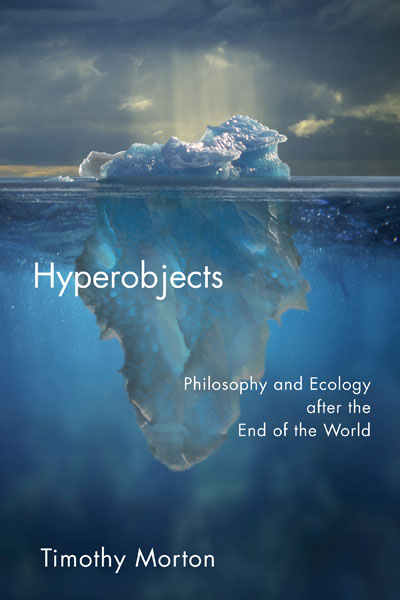
Hyperobjects (the book).
This summary isn’t intended to do justice to the full sweep of ideas in Timothy Morton’s Hyperobjects; if you want to appreciate the rigour of their ontological foundations, or the dizzying constellation of artistic and literary references they employ, you should read the book.
Rather, this intends to cover the ideas which seem to me to have the most explanatory power, those with which to better explore the world. Shamefully, I’m taking what I need right now.
Object Sets & Withdrawal.
The world is made up of objects; let’s take a raindrop as our worked example. But look closer and you’ll see that each such object is one of many in a set, and the set makes up another object; a rainstorm. Equally, our raindrop is itself made up of other objects; water molecules among other things. At the very lowest of these levels, at the quantum scale, things start behaving in ways the human mind can’t quite wrap itself around. The same is true at the very highest level. A global warming-affected climate (the cause of this raindrop dropping just here, just now) behaves in ways the human mind can’t quite wrap itself around, it’s a ‘hyperobject’.
We’ll dive into the features of a hyperobject shortly, but let’s stay with these object sets, operating across and between their different scales; what scale is it most meaningful to look at? Well… “There is no top object that gives all objects value and meaning, and no bottom object to which they can be reduced”. Not only that, but “all the relations between the objects and within them also count as objects”.
The closer we look at an object and try to contend with its relations to other objects, the more both the meaning and the essence of our object seem to be unavailable to us, they seem to withdraw from us.
But as well as being philosophers, we’re sensual humans; so let’s try to experience that raindrop with a sense, our sense of touch, it might not tell us much but it’ll give us an experience. The raindrop’s surface interacts with our skin and it immediately ceases to exist as the ‘dropness’ of it is dispersed across our skin, but a new object is created, the object of a sense of ‘wetness’. And where is that object? On our skin, in our nerves, somewhere in the neurone-mesh in which perception lives, now the moment’s passed, does the object exist as a memory? If we try to chase down any of these objects, their meaning and essence also withdraws from us, “things are standoffish,” we’re just left with temporary manifestations of things. This is true of all objects “but hyperobjects make this withdrawn quality obvious”.
Hyperobjects (the objects).
Morton identifies several features of hyperobjects and explores them all in turn, I’ll only take a few. They’re “massively distributed in time and space relative to humans,” imagining them as higher-dimensional objects helps make some sense of why their scale is so inaccessible to us. Inaccessible, but inescapable. Their scale humiliates us, it makes us realise that we’re not masters of our own destiny, that we’re not sovereign subjects standing separate from some imagined ‘Nature’ we could better govern. In so doing, it both explains our strange reactions to the evidence before us, and makes us realise there are problems with the way we think, and talk, about our world(s).
Massively Distributed in Time and Space.
“Hyperobjects are so huge and so long-lasting, compared with humans, that they obviously seem both vivid and slightly unreal.” “It is helpful to think of global warming as something like an ultra slow motion nuclear bomb. The incremental effects are almost invisible, until an island disappears underwater.” (This puts me in mind of Dr Anthony Costello’s more recent observation that average global warming of 1.2º can be compared to “6.2 billion Hiroshima bomb equivalents, measured between 1955 and 2021 [that’s] more than two bomb equivalents per second.”)
Even trying to flatten a hyperobject into the present doesn’t make it easier to access, “one only sees pieces of a hyperobject at any one moment. Thinking them is intrinsically tricky.” “[Their] precise scope remains uncertain while its reality is verified beyond question.” “Global warming is an object of which many things are distributed pieces… Like the image in a Magic Eye picture, global warming is real, but it involves a massive, counterintuitive perspective shift to see it.”
“[Humans] have been aware of enormous entities — some real, some imagined — for as long as they have existed. But this book is arguing that there is something quite special about the recently discovered entities… [Hyperobjects] seem to force something on us, something that affects some core ideas of what it means to exist, what Earth is, what society is.”
Higher-Dimensional Objects.
Hyperobjects are not, in reality, higher-dimensional (except to the extent that, like us, they’re four-dimensional but we find the fourth one, time, harder to incorporate into our imagination, especially at larger scales) but using higher-dimensionality as an analogy is useful.
Morton imagines a two-dimensional world, little creatures living out their existences on a flat plane, like a sheet of paper. How might they experience an ordinary, three-dimensional apple? It would first manifest in their world as a little dot which spreads out into a stain as the apple starts to pass through their plane, apple-skin green at its very edges, pale for most of its circumference, deeper colours in the middle nearer the dark-coloured circle of a core. Later, seeds would also start as dots in a pattern around that core, expanding slightly, briefly, only to disappear again. Around this time the growth of the green ring would slow and eventually it would start to shrink until it’s just a dot again, and then it would be gone. Forever.
Now let’s step back into our three-dimensional world and bring this analogy with us. “Since hyperobjects occupy a higher-dimensional phase space than we can experience directly, we can only experience somewhat constrained slices of them at any one time. The hyperobject global warming churns away, emitting ghosts of itself for my perusal. This horrible colossus is not capable of being visualized by humans.”
We can’t fit global warming in our heads. We can know that it exists, we can prove that without doubt, we can measure its manifestations, create models, make predictions with ever more accuracy, in the near-term and medium-term of where and how it might next manifest. We can feel the real, often brutal, too often deadly, effects of it on our world(s) but this isn’t the same as fitting the whole thing itself in our heads.
We can’t conceptualise it, but we can’t hide from it either.
Inescapable.
Experiences of global warming are wildly varied of course, but none of us escapes it entirely. “Every time I so much as change a confounded light bulb, I have to think about global warming… Global warming reaches into “my world” and forces me to use LEDs instead of bulbs with filaments.” We can’t escape it, because we’re inside it, and “inside the belly of the whale that is global warming, it’s oppressive and hot and there’s no “away” anymore.” “Waking up in the shadow of the unseen power of hyperobjects is like finding yourself in a David Lynch movie in which it becomes increasingly uncertain whether you are dreaming or awake.”
Not only that, but “we’ve woken up inside an object… where every decision is wrong”.
Hypocrisy, Inaction & Nature.
Global warming makes a hypocrites of each of us. “Doing nothing evidently won’t do at all. Drive a Prius? Why not (I do)? But it won’t solve the problem in the long run. Sit around criticizing Prius drivers? Won’t help at all. Form a people’s army and seize control of the state? Will the new society have the time and resources to tackle global warming?… Every position is “wrong”: every position, including and especially the know-it-all cynicism that thinks it knows better than anything else.”
And yet, by “postponing ethical and political decisions into an idealized future, the critique of incrementalism leaves the world just as it is, while maintaining a smug distance toward it.” We can’t let there be no action. There must be action. We must move on from the paralysis of trying to prove climate change is happening, which only serves to admit the possibility that it hasn’t yet been proved, that denial is something more than an understandable psychological spasm, an aftershock of humiliation. And we can’t just advocate for some imagined ideal of ‘Nature’ which is at best a misplaced claim of a sovereign subject separate from a nature “over there”, a fantasy we’ve created for ourselves, and at worst a society-wide act of greenwashing. “The ‘landscape’ look of agriculture is the original ‘greenwashing’. Objectors to wind farms are not saying “Save the environment!” but “Leave our dreams undisturbed!”.” Every position is wrong. Either way, “we are losing a fantasy — the fantasy of a being immersed in a neutral or benevolent Mother Nature — and a person who is losing a fantasy is a very dangerous person”.
Humiliation.
Our world is collapsing, both metaphorically and in our various realities. The cause is something so vast that we can’t fit it in our heads, yet we can’t escape it, and every action we could take is some shade of wrong. Worst of all, we’re in the “denial phase of grief regarding [our] role… not only are we waking up inside of a gigantic object, like finding ourselves in the womb again, but a toxic womb — but we are responsible for it.” And never mind the guilt, “hyperobjects seem to continue what Sigmund Freud considered the great humiliation of the human following Copernicus and Darwin… [they] seem to push this work to a yet more extreme limit”. Humans can no longer maintain the fantasy that we are the central character in the story of the universe, of life, or even of our planet. “…[A] person who is losing a fantasy is a very dangerous person.” We are decentered, and we are knocked off centre.
So what do we do?
Well, this isn’t a book of policy prescriptions, but it isn’t a book of inaction either. Rather it challenges us to find a philosophical position from which we can act. To do so, we must also discover where we stand in relation to the objects which make up our reality. Let’s first accept that “hyperobjects spell the end of environmentalisms that employ Nature (a tool of modernity) against modernity” and instead let’s “swear allegiance to coexistence with nonhumans […] without some nihilistic Noah’s Ark”. ‘Nature’ is a fantasy of the observer, it’s Nature-for-us, not nature-for-its-own-sake. ‘Landscape’ is the name for a view of a thing from which we are apart, not for an ecosystem of which we are a part.
Hyperobjects also reveal the limits of post-modernism, which decentres the individual but adopts a ‘meta-position’ and an air of irony towards the real world things its studies. Now, “the historic moment at which hyperobjects become visible by humans has arrived. This visibility changes everything. Humans enter a new age of sincerity… a time in which it is impossible to achieve a final distance toward the world”. “This distance is the main factor in producing the concept of Nature. So the curious phenomenon arises in which Nature dissolves just as hyperobjects start to ooze uncannily around us.” “What things are and how they seem and how we know them, is full of gaps, yet vividly real”.
For my part, this feels like a place from which action can be taken. There’s nothing nihilist or doomed about it, and we’re not adopting a passive meta-position. For a certain kind of thinking, its a destabilising place for sure, but it can be a freeing one. We needn’t be paralysed by our own inadequacy, nor stymied by a fear that we’re wrong. “Every position is wrong.”
And how should we act? Let’s take our cue from the hyperobject. Let’s not worry about perfecting solutions to the unimaginable problem, let’s take actions which are “massively distributed in time and space”. Let’s take actions which can coalesce into a hyperobject of their own. But let’s take actions.


Leave a reply to Climate & Ecology Thoughts: Art in the Time of Ecological Disruption, 2021 – The Why. The How. Cancel reply